Paint, Blade, and Three Stripes: Meet the Artists Rebuilding Adidas From Scratch
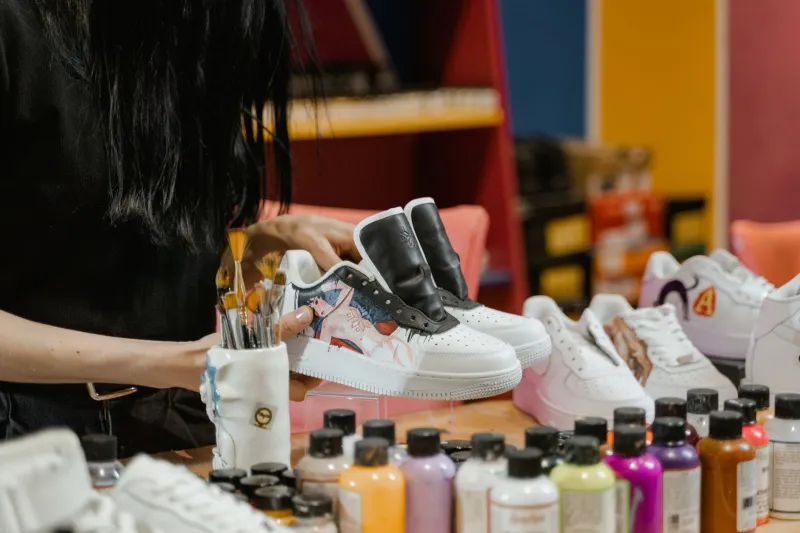
The shoe arrives deadstock, box-fresh, tissue paper still folded around the toe. Most people would lace them up and head out the door. Raquel Fuentes reaches for a seam ripper.
The 26-year-old Houston-based artist has built a following of nearly 80,000 on Instagram by doing things to Adidas that would make a retail purist wince — stripping panels from Stan Smiths, hand-painting Superstars with botanical illustrations, stitching new materials onto Forum lows that have no business looking as good as they do. Her clients have included musicians, athletes, and more than a few collectors who spent serious money on a pair specifically so she could take it apart.
"People always ask me if I feel bad cutting into a nice shoe," Raquel says. "I feel the opposite. The shoe is already designed. My job is to find out what it wants to be next."
A Movement With Deep Roots
Customization in sneaker culture isn't new — artists have been painting Air Forces and Jordans since at least the early 2000s. But the Adidas customization scene has developed its own distinct aesthetic identity, shaped partly by the brand's design language and partly by the particular community of creators it's attracted.
Adidas silhouettes — the Superstar, the Stan Smith, the Forum, the Samba, the Gazelle — tend to be architectural in a way that invites intervention. Clean lines, flat panels, minimal clutter. For a customizer, that's not a limitation. That's a runway.
"Adidas shoes are almost modular," says Detroit-based customizer Jerome "J-Roc" Calloway, who has been working on Three Stripes for over a decade. "The panels come apart cleanly, the materials are workable, and the silhouettes are iconic enough that even after you've transformed them, people still recognize what they came from. That tension between the original and the new thing — that's where the art lives."
J-Roc works out of a converted garage studio that looks equal parts cobbler shop and art classroom: Angelus paint bottles lined up like a color palette, heat guns hanging from pegboards, shelves of donor shoes waiting for their second life. His most recent project involved deconstructing three pairs of Ultraboosts and rebuilding them into a single conceptual piece that he displayed at a Detroit gallery show last fall.
Tools of the Trade
The modern Adidas customizer's toolkit is surprisingly accessible, which is part of why the movement keeps growing. The barrier to entry is low — a few bottles of Angelus leather paint, some acetone for surface prep, a decent brush set, and a willingness to ruin a few pairs before you find your footing.
But at the higher end of the craft, the work gets considerably more technical. Raquel uses a combination of hand-painting, airbrush, and digital illustration to plan her designs before a brush ever touches leather. J-Roc has invested in a laser cutter for precise panel work. Others in the community have added embroidery machines, 3D-printed hardware, and even custom vulcanized rubber components to their capabilities.
The materials customizers source are equally varied — Japanese selvedge denim, Italian leather scraps, surplus military canvas, vintage jacquard fabric. The goal isn't just to paint a shoe differently; it's to build something that feels genuinely new while remaining legible as Adidas.
"I want someone to look at my work and immediately know it started as a Samba," says Brooklyn-based customizer Aaliyah Chen, whose floral-deconstruction series went viral earlier this year. "But I also want them to feel like they've never seen anything like it. Both things have to be true."
The Business of One-of-One
Custom Adidas have carved out a legitimate secondary market that operates entirely outside the brand's official channels. Raquel's commissions start at $350 for basic paint work and climb well past $1,500 for full reconstruction projects. J-Roc's gallery pieces have sold for upward of $3,000. Aaliyah has a waitlist that stretches several months.
The buyers are a mix of collectors who want something genuinely unique, fashion-forward consumers who see custom sneakers as wearable art, and increasingly, people in the music and entertainment industries who need one-of-a-kind footwear for performances, videos, and public appearances.
There's also a growing collector market for customs specifically — people who acquire them not to wear but to display, treating custom sneakers the same way they'd treat a limited-edition print or a signed piece. Some of J-Roc's more ambitious constructions have ended up in private collections alongside original artwork.
"The resale market for customs is different from the resale market for retail pairs," explains Aaliyah. "You're not buying a shoe anymore. You're buying an artist's interpretation of a shoe. That's a completely different transaction."
Where the Brand Ends and the Artist Begins
The relationship between Adidas and the customization community is complicated in the way that most relationships between corporations and subcultures tend to be. The brand hasn't officially endorsed the underground modding scene, but it hasn't moved aggressively against it either — and some observers believe the creative energy generated by customizers actually enhances the cultural cachet of Adidas silhouettes overall.
A few customizers have been approached by Adidas or its retail partners for collaborative projects, though most describe these conversations as exploratory rather than formal. The general sentiment in the community is that independence is the point — the moment customization becomes institutional, something essential gets lost.
"The reason this work means something is because nobody told us to do it," Raquel says. "We did it because we had to. Because the shoe wasn't finished yet. It needed us."
For the growing network of artists cutting, painting, and rebuilding Three Stripes kicks in garages and studios across America, that creative imperative isn't going anywhere. If anything, it's just getting started.